


BIO
Lucie Jumonville is a Studio Arts major with a ceramics concentration pursuing her BFA at North Central College. She is also a College Scholars Honors student and Classical Studies minor. She has earned her Associates in Art from Waubonsee Community College. Her interest in mythology and storytelling is found throughout her art and inspired by her love of novels and folktales. She works primarily with clay, but occasionally you can find her creating two-dimensional work. Lucie has work in the permanent collection of Waubonsee Community College and has had her work appear in the 2024 edition of Horizons, the Waubonsee literary magazine.

EXHIBITIONS
"Flora and Fauna" November-December 2025 (two-person show)
Meiley-Swallow Gallery, North Central College, Naperville, Illinois"Material Complexities" September-October 2025 (group show)
Meiley-Swallow Gallery, North Central College, Naperville, Illinois"First Friday Student Showcase" May 2024 (group show)
Aurora Campus Library, Waubonsee Community College, Sugar Grove, Illinois
PERMANENT COLLECTIONS
Caterwauling Colony, 2025, Shimer Great Books School, North Central College, Naperville, IllinoisFishin' For Thoughts, 2024, Dyson Wellness Center, North Central College, Naperville, IllinoisBurger. More Burger, 2024, Waubonsee Community College, Sugar Grove, Illinois
The Divine
Below is the Artist Statement as presented with the Fall 2025 Exhibition "Flora and Fauna." Each piece has a statement to go with it as told from within the narrative.
Story keeping is the art and craft of telling stories to keep them alive and pass them down. My work is created from the perspectives of different story keepers sharing tales of the Divine Age. “Flora and Fauna” acts as an entry point into a mythological world of divine figures and their foes, and the ones passing down the stories of these strange beings. I use clay to create simplified, whimsical animal sculptures to explore how myth, nature, and storytelling intersect.Mythology offers a way to explain the creation of the natural world and its inhabitants. Beyond this, myth provides the world with structure through religious practices and the concept of the ‘Divine.’ I have created a narrative exploring both
how the Divine creates environments and act as stewards for these environments. By showing my four-legged creatures in different stages, I explore how divinity acts as an inherited title and duty rather than an inherent state of being. The Divine go through a life cycle where they grow into their power and titles before returning to the land and passing their power on. I also look at the corruption of the Divine and the struggle to adapt to the ensuing disruption of communities and life cycles. The Divine are caretakers and creators, when they are corrupted their communities splinter, becoming lost or corrupted as well.This body of work is primarily an introduction to the life cycles of the Divine, and all the inhabitants of this world. The work in “Flora and Fauna” is only the beginning of an ongoing series exploring this world and all of its inhabitants.
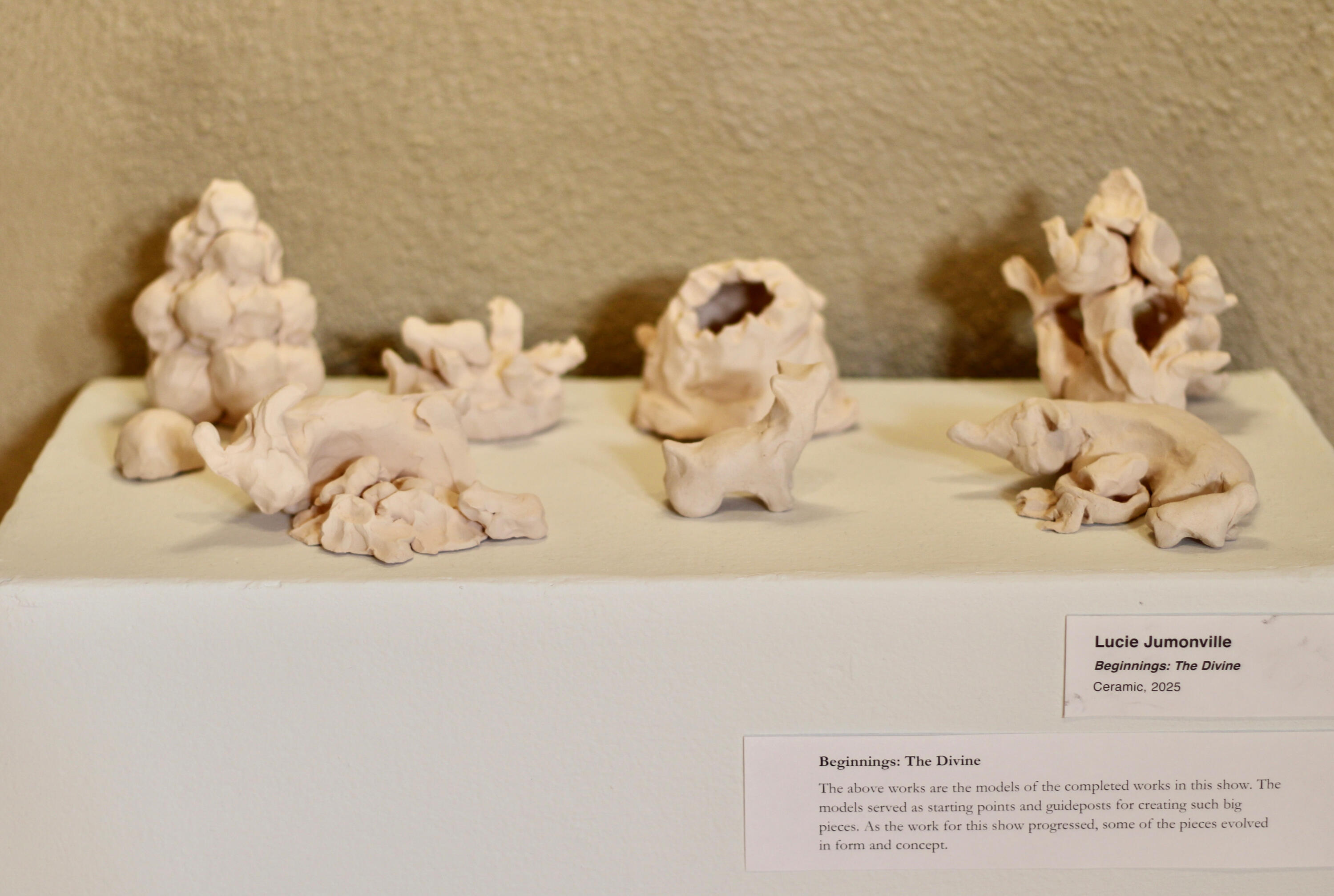
Beginnings: The Divine
The above works are the models of the completed works in this show. The models served as starting points and guideposts for creating such big pieces. As the work for this show progressed, some of the pieces evolved in form and concept.
Reclaimed
The inheritance cycle of the Divine necessitates the bringing of young to take the place of the Elders. When young Divine are born the essence of the Elder is passed to them and influences their future paths. During this transfer, the body of the Elder Divine is reclaimed by the land and creates a holy site. Many abbeys and temples were built on such sites in later ages.Excerpt from Baron’s “Encyclopedia of the Divine Age”
A Place to Grow
The Pilgrims act as caretakers for the young Divine. Notably, the Pilgrims did not originally have this relationship with the Divine. Over time, this symbiotic relationship developed to allow the Pilgrims to grow to extraordinary sizes, and in turn, the young Divine were protected from the Corrupted. There also seems to be some evidence that the Pilgrims aided Elderly Divine Ones, however, this data is as of yet inconclusive.Excerpt from Baron’s “Encyclopedia of the Divine Age”
In the Midst of Their Works
At the height of their power, the Divine created and stewarded natural wonders. These wonders, commonly referred to as the Divine Works, laid the foundations for the world. The Divine have territories they are bound and responsible to. In such territories, the land thrives and strange new creatures emerge from it. While not fully understood, it is known that the Divine performed ceremonies according to seasonal cycles with many variations based on their domain.Excerpt from Baron’s “Encyclopedia of the Divine Age”
A Reproduction of Malice
It was originally thought that the Corrupted ones only came from the Divine being corrupted, but the discovery of the colonies changed this. It is now understood that the Corrupted have two primary modes of reproduction: overcoming the Divine and the forming of colonies. The colonies seem to emerge from fallow land untouched by the Divine. Once individual Devourers are large enough, they detach from their colony and begin hunting for land and prey of their own.Excerpt from Baron’s “Encyclopedia of the Divine Age”
He Who Devours
Devourers are one of the most widespread predators in the Corrupted class. They primarily hunt the young of other species and are quite active in these hunts. However, it seems that once they reach a certain size, they become more sedentary and rely on their own younglings to bring food. While they are able to consume the bodies and power of the Divine, they are unable to digest their horns, which are often found in the remains or territories of Devourers. “He Who Devours” is the largest Devourer on record, and the territory he held remains scarred from his presence.Excerpt from Baron’s “Encyclopedia of the Divine Age”
The Novices
In an age after the Divine freely roamed the world, Novices were trained to stand in the footsteps of the Divine. Some rose to the occasion marvelously, while others became cautionary tales of how far one can fall.
Unknown attributionUpon admittance to the Order, Novices are expected to complete the following requirements in order to graduate:-Basic studies across all fields-Training in at least one specialization of: Healing, Guardianship, or Stewardship-Year-long pilgrimageExcerpt from the “Twill Abbey Novice Handbook”
Classical Mythology in art
Pandora and Her Creators
My ceramic sculpture subverts typical post-classical interpretations of the Pandora myth by reintroducing overlooked elements from the poet Hesiod, the oldest source for the myth. Post-classical interpretations of Pandora such as John William Waterhouse’s painting Pandora (c. 1896), flatten and show her as an object of female sin; conflated with Eve. They neglect that Pandora was a vessel for Zeus’s anger at deceitful humans, a gift and curse. In my interpretation Pandora is tightly interwoven with the vessel and craft; two ideas lost in later interpretations. In Hesiod, Pandora had a pithos, a large earthenware jar. In the Renaissance, pithos was misunderstood as pyxis (box), helping distort the myth. Pandora herself was made from clay, a material thematically connected, but completely absent in depictions. My piece reconnects artistic depictions of Pandora with the material, the vessel concept, and ambiguity of the original myth, while adding depth back into them.
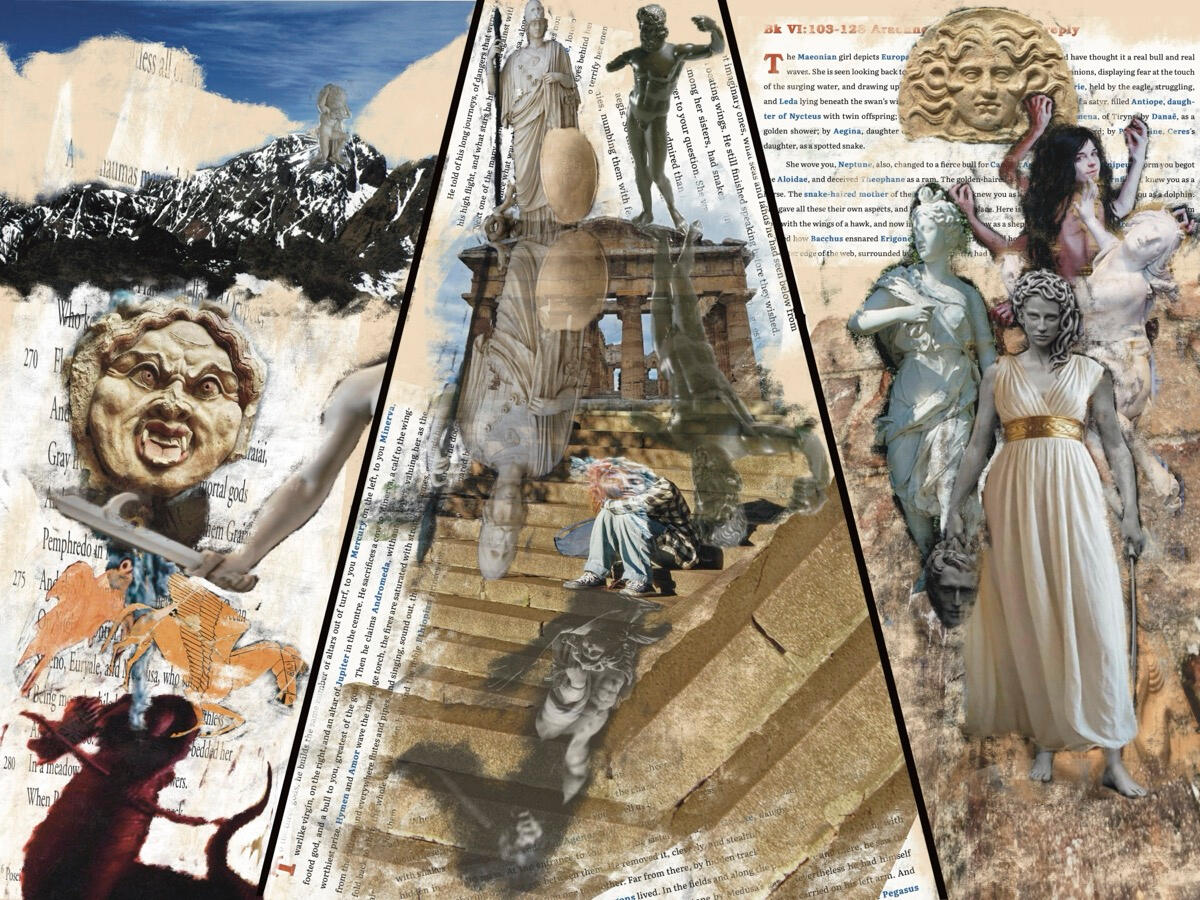
Monster. Victim. Protector.
My piece, Monster. Victim. Protector. is a digital collage that explores changing representations of Medusa from classical antiquity to the modern ages. It is also a comment on Luciano Garbati’s Medusa with the Head of Perseus (2007). Medusa’s portrayals have ranged from monstrous to idealized beauty in response to artistic trends and shifts in cultural standing. Recently, due to the #MeToo movement, Medusa has come to be a symbol for survivors of sexual assault, which lead to Garbati’s Medusa gaining new fame. Garbati’s sculpture portrays Medusa in Heroic Nudity thereby partaking in a long artistic tradition, but by doing so he contradicts the feminist message of his work. Garbati’s idealized Medusa perpetuates the idea of victims needing to be palatable to be supported and ignores a history of Medusa serving an apotropaic (protective) function. Additionally, the sculpture’s idealized appearance fits into conventional beauty standards and appeals to the ‘male gaze.’
relics
these saints we make
A piece made in part by collaboration through the different hands cast out of plaster. This work also pulls on the some of the traditions within the Catholic Church of the veneration of Saint Relics.
Ghost of the Fall
This piece is in conversation with These Saints We Make as an exploration of Catholicism and the almost haunting nature of religion.
functional work
Peony Dining Set
Peony Bud Vases
Sea Slug Platter Set